
Phosgene Manufacturing Plant Project Report 2026: Industry Trends, Plant Setup, Machinery, Raw Materials, Investment Opportunities, Cost and Revenue
Phosgene Manufacturing Plant Project Report (DPR) Summary:
IMARC Group's comprehensive DPR report, titled "Phosgene Manufacturing Plant Project Report 2026: Industry Trends, Plant Setup, Machinery, Raw Materials, Investment Opportunities, Cost and Revenue," provides a complete roadmap for setting up a phosgene manufacturing unit. The phosgene market is driven by rising demand for polycarbonate plastics, increasing production of isocyanates for polyurethane foams, expanding pharmaceutical synthesis activities, growth in agrochemical intermediates, and steady consumption in specialty chemical manufacturing. The global phosgene market size was valued at USD 5.15 Billion in 2025. According to IMARC Group estimates, the market is expected to reach USD 8.55 Billion by 2034, exhibiting a CAGR of 5.8% from 2026 to 2034.
This feasibility report covers a comprehensive market overview to micro-level information, such as unit operations involved, raw material requirements, utility requirements, infrastructure requirements, machinery and technology requirements, manpower requirements, packaging requirements, transportation requirements, etc. The phosgene manufacturing plant setup cost is provided in detail, covering project economics, capital investments (CapEx), project funding, operating expenses (OpEx), income and expenditure projections, fixed costs vs. variable costs, direct and indirect costs, expected ROI and net present value (NPV), profit and loss account, financial analysis, etc.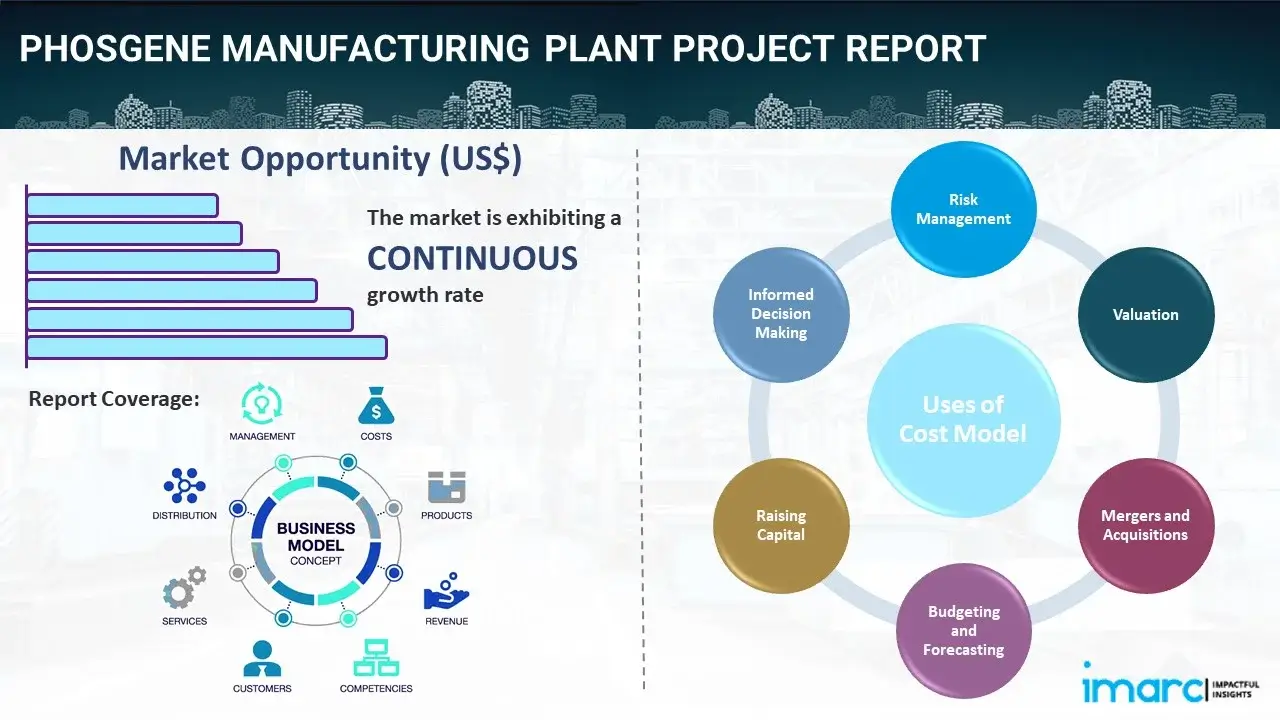
Access the Detailed Feasibility Analysis, 高清体育直播:Request Sample
What is Phosgene?
Phosgene (COCl₂) is a colorless chemical compound which exhibits high reactivity and forms through the combination of chlorine gas with carbon monoxide while using activated carbon as a catalyst. The main application of this compound involves its use as an intermediate material for manufacturing polycarbonates, methylene diphenyl diisocyanate (MDI), toluene diisocyanate (TDI), pharmaceutical intermediates, and agrochemicals. The production process begins with a controlled gas-phase reaction which occurs in a tubular reactor before the system undergoes purification and condensation followed by distribution to downstream consumption units. Chemical complexes usually produce and use phosgene on their premises because the substance contains toxic properties which create dangerous risks during transportation.Key Investment Highlights
- Process Used: Carbon monoxide and chlorine feed preparation, catalytic gas-phase reaction, heat removal, purification, condensation, storage under controlled conditions, and integration with downstream derivative units.
- End-use Industries: Polycarbonate manufacturers, polyurethane producers, pharmaceutical companies, agrochemical manufacturers, and specialty chemical producers.
- Applications: Used in the production of polycarbonates, isocyanates (MDI and TDI), carbamates, chloroformates, dyes, and pharmaceutical intermediates.
Phosgene Plant Capacity:
The proposed manufacturing facility is designed with an annual production capacity ranging between 10,000 - 30,000 MT, enabling economies of scale while maintaining operational flexibility.Phosgene Plant Profit Margins:
The project demonstrates healthy profitability potential under normal operating conditions. Gross profit margins typically range between 30-40%, supported by stable demand and value-added applications.- Gross Profit: 30-40%
- Net Profit: 15-22%
Phosgene Plant Cost Analysis:
The operating cost structure of a phosgene manufacturing plant is primarily driven by raw material consumption, particularly carbon monoxide, which accounts for approximately 60-70% of total operating expenses (OpEx).- Raw Materials: 60-70% of OpEx
- Utilities: 20-25% of OpEx
Financial Projection:
The financial projections for the proposed project have been developed based on realistic assumptions related to capital investment, operating costs, production capacity utilization, pricing trends, and demand outlook. These projections provide a comprehensive view of the project’s financial viability, ROI, profitability, and long-term sustainability.Major Applications:
- Polycarbonate Production: Serves as a key intermediate in creating high-performance engineering plastics for durable applications.
- Polyurethane Industry: Essential for producing MDI and TDI, which are used in foams, coatings, and adhesives.
- Pharmaceutical Synthesis: Used in preparing active pharmaceutical intermediates for the development of essential medications.
- Agrochemical Manufacturing: Applied in the production of carbamate-based chemicals used in crop protection and pest control.
Why Phosgene Manufacturing?
- Strong Demand from Polyurethane Sector: Growth in insulation, automotive, and furniture industries supports isocyanate consumption.
- Expansion of Engineering Plastics: Rising use of polycarbonates in electronics and automotive components drives phosgene demand.
- Integrated Chemical Complex Advantage: Having on-site production reduces the logistics risks and enhances cost efficiency.
- Diverse Downstream Applications: Broad usage across multiple chemical segments ensures steady demand.
- Export Potential for Derivatives: The increased global trade in polycarbonates and isocyanates will further enhance the opportunities for revenue.
Transforming Vision into Reality:
This report provides the comprehensive blueprint needed to transform your phosgene manufacturing vision into a technologically advanced and highly profitable reality.Phosgene Industry Outlook 2026:
The phosgene market is expanding because of continuous consumption growth of polyurethane foams and polycarbonate plastics. The construction and automotive industries are increasing their use of lightweight insulation materials and engineering plastics, which depend on phosgene-based intermediates for their production. Pharmaceutical and agrochemical sectors continue to utilize phosgene derivatives for specialized chemical synthesis. As such, Superform Chemistries Limited which previously operated under the name UPL Specialty Chemicals will achieve ISCC Plus certification in June 2025 for its sustainable manufacturing practices at the Dahej and Jhagadia units. The certification covers Phosgene-based chemistries products which require traceability and carbon footprint tracking and strong supply chain systems. Similarly, the major producers operate their complete production facilities for secure and effective management of this hazardous substance. Continuous improvements in reactor design and emission control systems and process automation technologies will also improve operational safety and production efficiency. The demand from downstream industries is creating stable market growth throughout essential regions.Leading Phosgene Manufacturers:
Leading manufacturers in the global phosgene industry include several multinational companies with extensive production capacities and diverse application portfolios. Key players include:- BASF SE
- Covestro AG
- Dow Inc.
- Huntsman Corporation
- Wanhua Chemical Group Co.
- OCI Company Ltd.
- Puyang Shenghuade Chemical Co.Ltd.
How to Setup a Phosgene Manufacturing Plant?
Setting up a phosgene manufacturing plant requires evaluating several key factors, including technological requirements and quality assurance. Some of the critical considerations include:- Detailed Process Flow: The manufacturing process is a multi-step operation that involves several unit operations, material handling, and quality checks. Below are the main stages involved in the phosgene manufacturing process flow:
- Unit Operations Involved
- Mass Balance and Raw Material Requirements
- Quality Assurance Criteria
- Technical Tests
- Site Selection: The location must offer easy access to key raw materials such as carbon monoxide and chlorine. Proximity to target markets will help minimize distribution costs. The site must have robust infrastructure, including reliable transportation, utilities, and waste management systems. Compliance with local zoning laws and environmental regulations must also be ensured.
- Plant Layout Optimization: The layout should be optimized to enhance workflow efficiency, safety, and minimize material handling. Separate areas for raw material storage, production, quality control, and finished goods storage must be designated. Space for future expansion should be incorporated to accommodate business growth.
- Equipment Selection: High-quality, corrosion-resistant machinery tailored for phosgene manufacturing must be selected. Essential equipment includes high-integrity tubular reactors, heat exchangers, gas compressors, condensers, scrubbers, storage tanks, and automated monitoring systems. All machinery must comply with industry standards for safety, efficiency, and reliability.
- Raw Material Sourcing: Reliable suppliers must be secured for raw materials like carbon monoxide and chlorine to ensure consistent production quality. Minimizing transportation costs by selecting nearby suppliers is essential. Sustainability and supply chain risks must be assessed, and long-term contracts should be negotiated to stabilize pricing and ensure a steady supply.
- Safety and Environmental Compliance: Safety protocols must be implemented throughout the manufacturing process of phosgene. Advanced monitoring systems should be installed to detect leaks or deviations in the process. Effluent treatment systems are necessary to minimize environmental impact and ensure compliance with emission standards.
- Quality Assurance Systems: A comprehensive quality control system should be established throughout production. Analytical instruments must be used to monitor product concentration, purity, and stability. Documentation for traceability and regulatory compliance must be maintained.
Project Economics:
Establishing and operating a phosgene manufacturing plant involves various cost components, including:- Capital Investment: The total capital investment depends on plant capacity, technology, and location. This investment covers land acquisition, site preparation, and necessary infrastructure.
- Equipment Costs: Equipment costs, such as those for high-integrity tubular reactors, heat exchangers, gas compressors, condensers, scrubbers, storage tanks, and automated monitoring systems, represent a significant portion of capital expenditure. The scale of production and automation level will determine the total cost of machinery.
- Raw Material Expenses: Raw materials, including core ingredients like carbon monoxide and chlorine, are a major part of operating costs. Long-term contracts with reliable suppliers will help mitigate price volatility and ensure a consistent supply of materials.
- Infrastructure and Utilities: Costs associated with land acquisition, construction, and utilities (electricity, water, steam) must be considered in the financial plan.
- Operational Costs: Ongoing expenses for labor, maintenance, quality control, and environmental compliance must be accounted for. Optimizing processes and providing staff training can help control these operational costs.
- Financial Planning: A detailed financial analysis, including income projections, expenditures, and break-even points, must be conducted. This analysis aids in securing funding and formulating a clear financial strategy.
Capital Expenditure (CapEx) and Operational Expenditure (OpEx) Analysis:
Capital Investment (CapEx): Machinery costs account for the largest portion of the total capital expenditure. The cost of land and site development, including charges for land registration, boundary development, and other related expenses, forms a substantial part of the overall investment. This allocation ensures a solid foundation for s🐼afe and efficient plant operations.
Operating Expenditure (OpEx): In the first year of operations, the operating cost for the phosgene manufacturing plant is projected to be significant, covering raw materials, utilities, depreciation, taxes, packiౠng, transportation, and repairs and maintenance. By the fifth year, the total operational cost is expected to increase substantially due to factors such as inflation, market fluctuations, and potential rises in the cost of key materials. Additional factors, including supply chain disruptions, rising consumer demand, and shifts in the global economy, are expected to contribute to this increase.
.webp)
Capital Expenditure Breakdown:
| Particulars | Cost (in US$) |
|---|---|
| Land and Site Development Costs | XX |
| Civil Works Costs | XX |
| Machinery Costs | XX |
| Other Capital Costs | XX |
To access CapEx Details, Request Sample
Operational Expenditure Breakdown:
| Particulars | In % |
|---|---|
| Raw Material Cost | 60-70% |
| Utility Cost | 20-25% |
| Transportation Cost | XX |
| Packaging Cost | XX |
| Salaries and Wages | XX |
| Depreciation | XX |
| Taxes | XX |
| Other Expenses | XX |
To access OpEx Details, Request Sample
Profitability Analysis:
| Particulars | Unit | Year 1 | Year 2 | Year 3 | Year 4 | Year 5 | Average |
|---|---|---|---|---|---|---|---|
| Total Income | US$ | XX | XX | XX | XX | XX | XX |
| Total Expenditure | US$ | XX | XX | XX | XX | XX | XX |
| Gross Profit | US$ | XX | XX | XX | XX | XX | XX |
| Gross Margin | % | XX | XX | XX | XX | XX | 30-40% |
| Net Profit | US$ | XX | XX | XX | XX | XX | XX |
| Net Margin | % | XX | XX | XX | XX | XX | 15-22% |
To access Financial Analysis, Request Sample
Latest Industry Developments:
- October 2025: Saltigo planned to present solutions at CPHI Frankfurt 2025 to help pharmaceutical companies strengthen supply chains through reshoring and producing more sustainably. Saltigo maintains regulatory compliance and scalable operations and transparent carbon footprint measurement through its German production facilities, advanced phosgene chemistry and flow process technologies which serve European pharmaceutical value chains.
Report Coverage:
| Report Features | Details |
|---|---|
| Product Name | Phosgene |
| Report Coverage | Detailed Process Flow: Unit Operations Involved, Quality Assurance Criteria, Technical Tests, Mass Balance, and Raw Material Requirements Land, Location and Site Development: Selection Criteria and Significance, Location Analysis, Project Planning and Phasing of Development, Environmental Impact, Land Requirement and Costs Plant Layout: Importance and Essentials, Layout, Factors Influencing Layout Plant Machinery: Machinery Requirements, Machinery Costs, Machinery Suppliers (Provided on Request) Raw Materials: Raw Material Requirements, Raw Material Details and Procurement, Raw Material Costs, Raw Material Suppliers (Provided on Request) Packaging: Packaging Requirements, Packaging Material Details and Procurement, Packaging Costs, Packaging Material Suppliers (Provided on Request) Other Requirements and Costs: Transportation Requirements and Costs, Utility Requirements and Costs, Energy Requirements and Costs, Water Requirements and Costs, Human Resource Requirements and Costs Project Economics: Capital Costs, Techno-Economic Parameters, Income Projections, Expenditure Projections, Product Pricing and Margins, Taxation, Depreciation Financial Analysis: Liquidity Analysis, Profitability Analysis, Payback Period, Net Present Value, Internal Rate of Return, Profit and Loss Account, Uncertainty Analysis, Sensitivity Analysis, Economic Analysis Other Analysis Covered in The Report: Market Trends and Analysis, Market Segmentation, Market Breakup by Region, Price Trends, Competitive Landscape, Regulatory Landscape, Strategic Recommendations, Case Study of a Successful Venture |
| Currency | US$ (Data can also be provided in the local currency) |
| Customization Scope | The report can also be customized based on the requirement of the customer |
| Post-Sale Analyst Support | 10-12 Weeks |
| Delivery Format | PDF and Excel through email (We can also provide the editable version of the report in PPT/Word format on special request) |
Key Questions Answered in This Report?
- How has the phosgene market performed so far and how will it perform in the coming years?
- What is the market segmentation of the global phosgene market?
- What is the regional breakup of the global phosgene market?
- What are the price trends of various feedstocks in the phosgene industry?
- What is the structure of the phosgene industry and who are the key players?
- What are the various unit operations involved in a phosgene manufacturing plant?
- What is the total size of land required for setting up a phosgene manufacturing plant?
- What is the layout of a phosgene manufacturing plant?
- What are the machinery requirements for setting up a phosgene manufacturing plant?
- What are the raw material requirements for setting up a phosgene manufacturing plant?
- What are the packaging requirements for setting up a phosgene manufacturing plant?
- What are the transportation requirements for setting up a phosgene manufacturing plant?
- What are the utility requirements for setting up a phosgene manufacturing plant?
- What are the human resource requirements for setting up a phosgene manufacturing plant?
- What are the infrastructure costs for setting up a phosgene manufacturing plant?
- What are the capital costs for setting up a phosgene manufacturing plant?
- What are the operating costs for setting up a phosgene manufacturing plant?
- What should be the pricing mechanism of the final product?
- What will be the income and expenditures for a phosgene manufacturing plant?
- What is the time required to break even?
- What are the profit projections for setting up a phosgene manufacturing plant?
- What are the key success and risk factors in the phosgene industry?
- What are the key regulatory procedures and requirements for setting up a phosgene manufacturing plant?
- What are the key certifications required for setting up a phosgene manufacturing plant?
Report Customization
While we have aimed to create an all-encompassing phosgene plant project report, we acknowledge that individual stakeholders may have unique demands. Thus, we offer customized report options that cater to your specific requirements. Our consultants are available to discuss your business requirements, and we can tailor the report's scope accordingly. Some of the common customizations that we are frequently requested to make by our clients include:- The report can be customized based on the location (country/region) of your plant.
- The plant’s capacity can be customized based on your requirements.
- Plant machinery and costs can be customized based on your requirements.
- Any additions to the current scope can also be provided based on your requirements.
Why Buy IMARC Reports?
- The insights provided in our reports enable stakeholders to make informed business decisions by assessing the feasibility of a business venture.
- Our extensive network of consultants, raw material suppliers, machinery suppliers and subject matter experts spans over 100+ countries across North America, Europe, Asia Pacific, South America, Africa, and the Middle East.
- Our cost modeling team can assist you in understanding the most complex materials. With domain experts across numerous categories, we can assist you in determining how sensitive each component of the cost model is and how it can affect the final cost and prices.
- We keep a constant track of land costs, construction costs, utility costs, and labor costs across 100+ countries and update them regularly.
- Our client base consists of over 3000 organizations, including prominent corporations, governments, and institutions, who rely on us as their trusted business partners. Our clientele varies from small and start-up businesses to Fortune 500 companies.
- Our strong in-house team of engineers, statisticians, modeling experts, chartered accountants, architects, etc. have played a crucial role in constructing, expanding, and optimizing sustainable manufacturing plants worldwide.
Need more help?
- Speak to our experienced analysts for insights on the current market scenarios.
- Include additional segments and countries to customize the report as per your requirement.
- Gain an unparalleled competitive advantage in your domain by understanding how to utilize the report and positively impacting your operations and revenue.
- For further assistance, please connect with our analysts.


Factory Setup Services


Site Selection Services


Factory Audit Services


 Inquire Before Buying
 Speak to an Analyst
 Request Brochure
 Request Customization